HubSpot Marketing Hub Pricing: Complete 2026 Breakdown
HubSpot Marketing Hub is one of the most capable marketing automation platforms on the market — and one of the most complex to price. Between contact-based fees, per-seat costs, mandatory onboarding charges, and inter-hub dependencies, the sticker price rarely reflects what you'll actually pay. This guide cuts through the noise with exact numbers so you can budget accurately before you buy.
HubSpot Marketing Hub Plan Overview
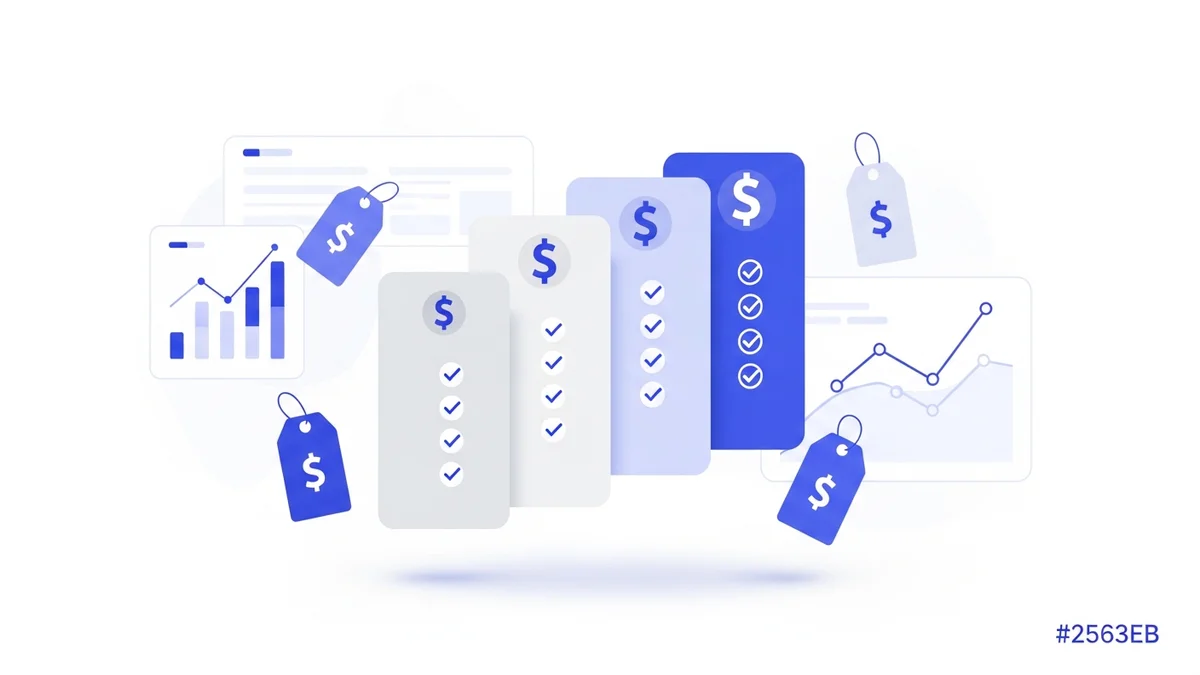
Marketing Hub is sold in four tiers: a free CRM layer plus Starter, Professional, and Enterprise. Each step up unlocks more contacts, more automation depth, and more reporting power — but the cost jumps are steep.
| Plan | Monthly Billing | Annual Billing | Included Contacts |
|---|---|---|---|
| Free CRM | $0 | $0 | Up to 1,000,000 (basic) |
| Starter | $15/seat/month | ~$15/seat/month (annual commitment required) | 1,000 marketing contacts |
| Professional | $890/month | $890/month (billed annually) | 2,000 marketing contacts |
| Enterprise | $3,600/month | $3,600/month (billed annually) | 10,000 marketing contacts |
Note: HubSpot requires an annual commitment across all paid tiers. Monthly billing is technically available on some plans but at a higher effective rate. Most businesses are locked into a 12-month contract from day one.
What's Included in Each Plan
Free CRM
HubSpot's free Smart CRM supports up to 2 users and gives you access to up to 1,000,000 contacts with unlimited deals and tasks. You get basic contact tracking, a simple deals pipeline, and limited email marketing tools. The free tier is genuinely useful for solopreneurs validating a list-building strategy, but you'll hit its walls fast — no automation, no A/B testing, no custom reporting.
Starter — $15/seat/month
The Starter plan starts at $15 per seat per month and includes 1,000 marketing contacts. It unlocks email marketing, ad management, basic landing pages, and simple forms. This is HubSpot's entry point for teams that want to move beyond the free tier. Key inclusions:
- Email marketing with HubSpot branding removed (on paid plans)
- 1,000 marketing contacts included
- Basic ad retargeting (Google, Facebook, LinkedIn)
- Simple list segmentation
- 1 automation per form/landing page (not full workflow automation)
- Live chat and bots (basic)
What Starter lacks is the main reason most businesses outgrow it quickly: no omni-channel marketing automation, no A/B testing for emails or landing pages, and no custom reporting dashboards.
Professional — $890/month
At $890/month, Marketing Hub Professional is where HubSpot's automation capabilities become genuinely competitive. It includes 2,000 marketing contacts and adds:
- Full marketing automation with multi-step workflows
- A/B testing for emails and landing pages
- Omni-channel campaign management
- Behavioral event triggers
- Social media management (publishing and monitoring)
- SEO recommendations and content strategy tools
- Dynamic personalization
- Custom reporting dashboards (up to 25 dashboards)
- Video hosting and management
- Salesforce integration (two-way sync)
Critical hidden cost: Professional requires a mandatory one-time onboarding fee of $1,500. This is non-negotiable and is billed before your first billing cycle. It is not a setup service you can waive.
Enterprise — $3,600/month
Enterprise is positioned for large marketing teams managing complex, multi-brand or multi-region operations. It includes 10,000 marketing contacts and adds:
- Multi-touch revenue attribution reporting
- Predictive lead scoring
- Custom behavioral events
- Sandboxes for testing
- Hierarchical teams and permissions
- Advanced partitioning (divide assets by team/brand)
- Customer journey analytics
- Up to 50 reporting dashboards
Enterprise carries a mandatory onboarding fee of $3,500 in addition to the monthly cost. Total first-year spend on Enterprise alone (excluding contacts overages and add-ons) is at minimum $46,700.
Hidden Costs: What HubSpot Doesn't Advertise Up Front
HubSpot's published prices cover only the baseline. Real-world costs are consistently higher due to several structural pricing mechanisms:
Marketing Contact Overages
HubSpot charges based on "marketing contacts" — contacts you actively email or target. Starter includes 1,000; Professional includes 2,000; Enterprise includes 10,000. Once you exceed your included contacts, you pay overage rates in incremental tiers. A Professional customer with 10,000 marketing contacts will pay significantly more than the base $890/month — often $1,200–$1,500/month depending on the contact band they fall into.
Newsletter
Get the latest SaaS reviews in your inbox
By subscribing, you agree to receive email updates. Unsubscribe any time. Privacy policy.
Mandatory Onboarding Fees
- Professional: $1,500 one-time, non-negotiable
- Enterprise: $3,500 one-time, non-negotiable
These fees are not optional and are not refundable. They are billed when you sign up, before you use a single feature.
Inter-Hub Dependencies (Feature Paywalls)
HubSpot's biggest hidden cost is the feature lock-in across hubs. Automated SMS, for example, requires purchasing Marketing Hub Professional ($890/month) plus a separate SMS add-on. Native calling is capped at 500 pooled minutes on Starter, 2,000 minutes on Professional, and 3,000 on Enterprise. Teams that need advanced calling or SMS functionality often end up paying for both HubSpot and a third-party integration.
Seat Costs for Advanced Tiers
Sales Hub Professional is $100/seat/month; Enterprise is $150/seat/month. A five-person sales team on Professional pays $500/month in seats alone — plus the $1,500 onboarding fee — before any Marketing Hub costs are added. A combined Sales Hub Pro + Marketing Hub Pro setup for five people costs $1,390/month plus $1,500 upfront.
Implementation Costs
Third-party HubSpot implementation typically runs $12,000–$60,000 depending on complexity. This is separate from HubSpot's mandatory onboarding fee and is required for most mid-sized companies attempting a full migration or complex automation build-out.
HubSpot Marketing Hub vs. Competitors: Pricing Comparison
| Platform | Entry Paid Plan | Mid-Tier Plan | Top Tier / Advanced | Onboarding Fee |
|---|---|---|---|---|
| HubSpot Marketing Hub | $15/seat/month (1,000 contacts) | $890/month (2,000 contacts) | $3,600/month (10,000 contacts) | $1,500–$3,500 mandatory |
| ActiveCampaign | $15/month (1,000 contacts) | $49/month (1,000 contacts, Plus) | $79/month (1,000 contacts, Pro) | None |
| GoHighLevel | $97/month (unlimited contacts) | $297/month (unlimited contacts) | $497/month (Agency Pro) | None |
| Mailchimp | $13/month (500 contacts, Essentials) | $20/month (500 contacts, Standard) | $350/month (10,000 contacts, Premium) | None |
| Kartra | $99/month (2,500 contacts) | $189/month (12,500 contacts) | $429/month (25,000 contacts) | None |
The comparison makes one thing clear: HubSpot Professional at $890/month is 11x the price of ActiveCampaign's Plus tier and 3x the price of GoHighLevel's unlimited plan. For pure marketing automation value per dollar, HubSpot is the most expensive option in this category — though it does offer deeper CRM integration and a broader native ecosystem than most alternatives.
Who Each HubSpot Marketing Hub Plan Is Best For
Free CRM — Best for solo operators testing HubSpot
If you're running a personal brand or one-person consulting business and want to organize contacts and track deals without spending anything, the free tier delivers real value. However, it's not a substitute for a marketing automation platform. Once you need to run email sequences, segment audiences, or automate lead nurturing, you'll need to upgrade or switch to a dedicated tool like Systeme.io, which offers a free plan with full funnel-building and email automation included.
Starter ($15/seat/month) — Best for early-stage teams under 2,000 contacts
Starter is appropriate for early-stage SaaS companies or small agencies that have outgrown spreadsheets but aren't ready to commit to a five-figure annual spend. If your list is under 2,000 contacts, you're running basic email campaigns, and you primarily need a CRM with light email functionality, Starter works. It stops being cost-effective the moment you need workflow automation or A/B testing — both of which require jumping to Professional.
Professional ($890/month) — Best for growth-stage B2B companies with 5–25 person marketing teams
Professional is the core enterprise-adjacent plan that most HubSpot customers land on. It's the right fit for B2B companies running multi-touch nurture sequences, managing large ad budgets across Google and LinkedIn, and needing tight CRM alignment between marketing and sales. The $890/month baseline is justifiable if you're generating $1M+ in annual pipeline, have a dedicated marketing ops person to manage it, and genuinely need the Salesforce two-way sync or advanced attribution. If you don't need those features, ActiveCampaign Professional at $79/month covers most of the same automation ground at a fraction of the cost.
Enterprise ($3,600/month) — Best for multi-brand or enterprise organizations with dedicated RevOps teams
Enterprise is built for companies running multiple brands, managing complex permissions across regional teams, or requiring enterprise-grade data governance and attribution. At $3,600/month plus $3,500 onboarding, it only makes sense if you're generating $10M+ in revenue and have a team dedicated to operating the platform. Most companies that reach this tier are using HubSpot as the system of record across marketing, sales, and service — not just as a campaign tool.
Money-Saving Tips for HubSpot Marketing Hub
- Clean your contact list before upgrading. HubSpot charges based on marketing contacts, not total contacts. Remove unengaged subscribers before your billing date to stay in a lower contact band. A list scrub from 3,000 to 1,800 contacts can keep you on Starter rather than triggering an overage charge on Professional.
- Negotiate the onboarding fee. The mandatory onboarding fee ($1,500 for Professional, $3,500 for Enterprise) is technically non-negotiable per HubSpot's standard terms, but larger deals sometimes include onboarding fee waivers or credits. If you're signing a multi-year contract or purchasing multiple hubs, ask your rep directly.
- Bundle hubs for a combined discount. HubSpot's CRM Suite (all hubs bundled) is cheaper than purchasing hubs individually. If your team needs Sales Hub and Marketing Hub at Professional level, the bundle pricing can reduce total monthly cost meaningfully compared to buying each separately.
- Use the annual commitment strategically. All paid tiers require annual billing. Don't sign mid-fiscal-year unless you've mapped out your contact growth for the next 12 months — contact overage costs can erase your initial savings if your list grows faster than projected.
- Evaluate if you truly need Professional. The gap between Starter and Professional is enormous — from $15/seat to $890/month flat. Before committing, audit whether you need workflow automation and A/B testing specifically from HubSpot. Platforms like Kartra or GoHighLevel offer comparable automation, landing pages, and email marketing at $99–$297/month with no onboarding fees, which may serve your needs better at a lower total cost.
- Start with a free HubSpot CRM account. You can import all your contacts into the free CRM, test the interface, and validate whether your team will actually adopt the platform before committing to a $1,390+/month annual contract.
- Request a multi-hub pilot period. Enterprise prospects can sometimes negotiate a 30–60 day pilot before full contract execution. Use this window to validate attribution reporting and workflow automation before you're locked in.
Is HubSpot Marketing Hub Worth the Price?
HubSpot Marketing Hub is a genuinely powerful platform — but its pricing model is engineered to extract maximum revenue at each stage of your growth. The Starter plan is reasonably priced at $15/seat/month but too limited for serious marketing automation. The jump to Professional at $890/month (plus a mandatory $1,500 onboarding fee) is the most significant cliff in the pricing structure, and it's only justifiable for teams that will actively use advanced workflow automation, multi-touch attribution, and deep CRM integration.
For companies that primarily need landing pages, funnel builders, and email campaigns, the value equation rarely favors HubSpot over focused alternatives. Leadpages covers landing page creation at a fraction of the cost. ActiveCampaign delivers comparable email automation for $15–$79/month. And GoHighLevel offers an all-in-one agency platform at $97–$297/month with no onboarding fees and unlimited contacts.
HubSpot is the right choice when your organization genuinely needs the breadth of its ecosystem — marketing, sales, service, and data unified in a single platform — and has the budget and team to operate it properly. For everyone else, the total cost of ownership often exceeds the value delivered, particularly in the critical $0–$2M revenue range where marketing budgets are tightest.